TL;DR: Claude Code exports OTLP logs, metrics, and traces if a handful of env vars are set before a session starts, traces need one extra beta flag on top of the others, easy to miss since nothing errors if you skip it. A local
otel-collectorwrites the raw export to JSONL, and a small polling sidecar turns that intoclaude_usage.csv(model, cost, tokens, tool calls) andclaude_spans.csv(the call tree: interaction -> tool -> llm_request), with nothing to trigger by hand. Repo here.
The Goal
I wanted a running log of what my Claude Code sessions actually cost: tokens per model, dollars, which tools got called and how often they succeeded. Claude Code doesn’t have a built-in dashboard for this, but it does speak OpenTelemetry, so the plan was to catch that export locally and turn it into something I could open in a spreadsheet.
Telemetry Has to Be on Before You Start
The first thing I tried was turning on export mid-session. That doesn’t
work: Claude Code reads its telemetry configuration once, at startup. There
is no way to retroactively enable export for a session that’s already
running, and no built-in buffer-and-replay-later feature either. If you want
a session’s traces, the env vars have to be set in the shell before
claude launches:
The second thing that has to be true: something has to actually be listening on that endpoint when Claude Code starts. If nothing’s there, the exporter just fails quietly and you get nothing. So the env vars alone aren’t the setup, they’re the last step.
That’s the setup for logs and metrics. Traces are a separate beta feature,
gated behind a flag that isn’t mentioned anywhere near the other telemetry
docs, so it’s easy to wire up a collector with a traces pipeline (like the
one below) and never notice it’s receiving nothing. OTEL_TRACES_EXPORTER=otlp
by itself does nothing; Claude Code silently skips span creation unless
CLAUDE_CODE_ENHANCED_TELEMETRY_BETA=1 is also set:
I originally shipped this repo without that flag. The collector’s traces
pipeline was live and listening, claude_spans.csv existed, and it just
stayed empty forever with no error on either side. Confirmed it two ways:
OTEL_TRACES_EXPORTER=console prints real spans to stdout once the beta
flag is set, and pointing a throwaway collector at the OTLP endpoint with
the flag on shows an actual resourceSpans payload arrive over gRPC.
Without it, neither ever produces a trace.
Architecture
| |
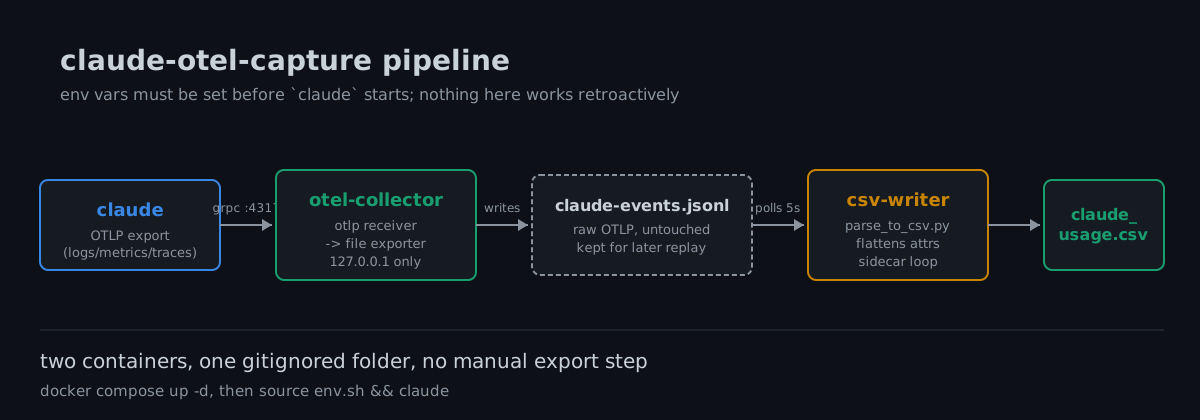
Two containers. otel-collector receives OTLP over gRPC/HTTP and writes the
raw export straight to a JSONL file, nothing parsed or dropped. csv-writer
polls that file every five seconds and regenerates both CSVs, so there’s no
command to remember after the fact, the files just stay current while the
stack is up.
The Collector Config
otelcol-contrib needs a receiver and an exporter; the file exporter is
enough for this, no backend required yet:
| |
The docker-compose.yml binds the OTLP ports to 127.0.0.1 on purpose.
This receiver has no auth and no TLS, so exposing it on 0.0.0.0 means
anyone on the LAN can inject fake telemetry into your collector:
| |
Turning JSONL into a CSV
The raw export is nested OTLP: resourceLogs -> scopeLogs -> logRecords,
each with an attributes array instead of a flat object. The script filters
to the three event types worth graphing, api_request, tool_result, and
tool_decision, and flattens their attributes into one row per event, keyed
by session_id:
| |
api_request rows carry model, cost, and token counts; tool_result and
tool_decision carry which tool ran, whether it succeeded, and whether it
was auto-accepted or needed a prompt. Group by session_id and you have a
per-session cost and tool-usage breakdown. A few rows from a real
claude_usage.csv (all 16 columns, scroll right on narrow screens):
| timestamp | session_id | event_type | model | tool_name | decision | source | success | error_type | cost_usd | duration_ms | input_tokens | output_tokens | cache_read_tokens | cache_creation_tokens | tool_use_id |
|---|---|---|---|---|---|---|---|---|---|---|---|---|---|---|---|
| 2026-07-04T19:41:05.216Z | 4255b08c… | tool_decision | Read | accept | config | toolu_01LV… | |||||||||
| 2026-07-04T19:41:05.218Z | 4255b08c… | api_request | claude-sonnet-5 | 0.076066 | 2958 | 2 | 101 | 30342 | 10907 | ||||||
| 2026-07-04T19:41:05.221Z | 4255b08c… | tool_result | Read | true | 5 | toolu_01LV… | |||||||||
| 2026-07-04T19:41:46.045Z | 4a4f71f6… | tool_decision | Grep | accept | config | toolu_018W… | |||||||||
| 2026-07-04T19:41:46.052Z | 4a4f71f6… | api_request | claude-opus-4-8 | 0.26328 | 4415 | 9702 | 242 | 0 | 20872 |
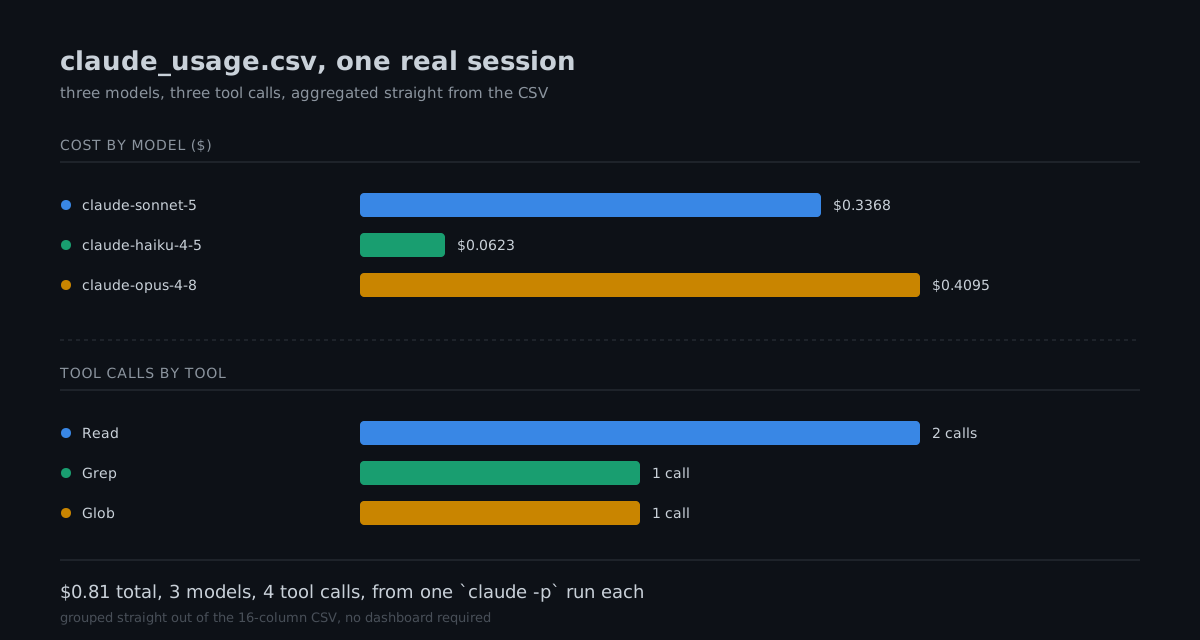
These are real rows, one claude -p call each, on Sonnet and Opus, one reading a
file and one grepping one. Grouped by model and by tool, the same session looks
like this:
Spans Get Their Own CSV
Once the beta flag is on, resourceSpans shows up in the same JSONL, structurally
different enough from log records that it gets its own parser and its own
output file, claude_spans.csv, rather than trying to force it into the
FIELDS schema above:
| |
span.get("parentSpanId", "") is the whole reason this is worth a second file:
it’s how a flat list of spans turns back into a call tree. One real turn,
same trace_id on every row:
| span_id | parent_span_id | span_name | model | duration_ms | ttft_ms | stop_reason |
|---|---|---|---|---|---|---|
| b9627b1d… | (root) | claude_code.interaction | 8437 | |||
| 51fa875b… | b9627b1d… | claude_code.llm_request | claude-sonnet-5 | 4694 | 2740 | tool_use |
| 7e062ead… | b9627b1d… | claude_code.tool | 11 | |||
| 8bdf191c… | 7e062ead… | claude_code.tool.execution | 3 | |||
| 3e556636… | b9627b1d… | claude_code.llm_request | claude-sonnet-5 | 3142 | 1984 | end_turn |
Read top to bottom, that’s one turn: the model call decides to use a tool
(stop_reason: tool_use), the tool runs (claude_code.tool wraps
claude_code.tool.execution), and a second model call ends the turn
(stop_reason: end_turn), all three children of the one
claude_code.interaction root span. claude_usage.csv has the same
information flattened into log events; claude_spans.csv has the shape of
the turn.
Subagents Stay in the Same Trace
The reason agent_id is in SPAN_FIELDS at all: I wanted to know what a
session looks like when the main agent dispatches subagents on a different
model. So I ran this session on Opus and had it spawn three Sonnet subagents
(each reading a file and summarizing it), telemetry and the beta flag on the
whole time. The trace answered three things I’d been guessing at.
First, it’s all one trace and one session. Every span, the Opus main and all
three Sonnet subagents, carries the same trace_id and the same session.id.
A subagent does not open its own session or its own trace, so you cannot tell
them apart by session.id.
Second, agent_id is what tells them apart. The main agent’s llm_request
spans have an empty agent_id; each subagent’s spans carry a distinct one.
That single attribute is the only thing separating the Opus turns from the
Sonnet ones in the trace, which is exactly why it earns a column.
Third, a subagent’s spans hang off the parent’s tool span. When the main agent
calls the Task tool, that produces a claude_code.tool and a
claude_code.tool.execution span belonging to the main agent (no agent_id),
and everything the subagent then does nests underneath that execution span. One
real dispatch from this session, same trace_id on every row:
| span_id | parent_span_id | span_name | agent_id | model | stop_reason |
|---|---|---|---|---|---|
| aaf45133… | 3148a886… | claude_code.tool | |||
| f253fecb… | aaf45133… | claude_code.tool.execution | |||
| 8c8a24ce… | f253fecb… | claude_code.llm_request | a9f513d5… | claude-sonnet-5 | tool_use |
| c1cd61df… | f253fecb… | claude_code.tool | a9f513d5… | ||
| 780673bc… | f253fecb… | claude_code.llm_request | a9f513d5… | claude-sonnet-5 | end_turn |
The top two rows are the main Opus agent invoking the Task tool. The three
below them are the Sonnet subagent’s own turn (two model calls wrapping its one
Read), all parented to the tool.execution span above and all stamped with
its agent_id. So parent_span_id gives you the nesting and agent_id gives
you attribution: which subagent, on which model, under which parent turn. The
3148a886… those top rows hang off is the session’s claude_code.interaction
root, which is not in this capture: it stays open until the session ends, and
spans only export once they close (see Gotchas). Cost still comes from the log
side (spans carry tokens but not cost_usd), and in this run that split out to
$0.74 of Opus against $0.25 of Sonnet across the three subagents.
Setup
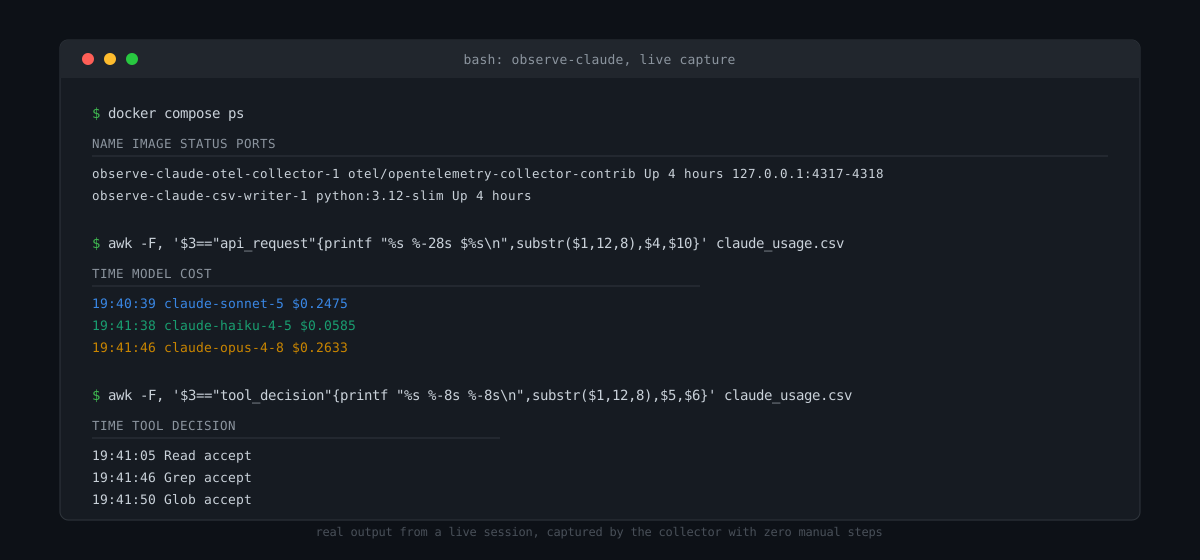
claude_usage.csv updates itself every five seconds while the stack is up,
nothing else to run. Here’s what that actually looks like, both containers up
and a couple of real rows pulled straight out of the CSV:
Gotchas
- The file exporter holds an open handle. Deleting
data/claude-events.jsonlfrom the host while the collector is running leaves it writing into a deleted, invisible inode until the container restarts. If you need to reset it,docker compose restart otel-collector, don’trmthe file while it’s live. This one cost me an hour of “why is my CSV empty” before I noticed the container had never stopped writing, just to nowhere I could see. OTEL_TRACES_EXPORTER=otlpalone gets you nothing. The collector’stracespipeline receiver is listening fine, but Claude Code itself never creates a span unlessCLAUDE_CODE_ENHANCED_TELEMETRY_BETA=1is also set. There’s no warning on either end,claude_spans.csvjust stays an empty header row forever. This is the mistake the first version of this post and repo made.user.emailand account UUIDs are in the raw export. Prompt and response text are redacted by default, but the JSONL still isn’t something to commit.data/and*.csvare gitignored in the repo.- The root
claude_code.interactionspan is missing until the session ends. A span is exported when it closes, not when it opens, so the collector only ever receives finished spans. The per-step spans (llm_request,tool,tool.execution) close as each step completes and arrive within seconds, but the interaction span that wraps the whole session stays open, and therefore unexported, until the session exits. In a one-shotclaude -prun that happens immediately, so the root is present; in a long-running interactive session it is absent, and every captured span points at aparent_span_idthat never arrives. Closing the session ends that root and flushes it on shutdown, so leave the collector up until then. And since restarting the collector truncates the JSONL (that’s the reset above), don’t bounce it right as you close a session or you lose that final root span.
Phase 2
data/claude-events.jsonl is the full, untouched OTLP export, so nothing
needs to be replayed from Claude Code itself to backfill a different
backend later. A second collector with a filelog/otlpjsonfile receiver
pointed at that file and a clickhouse exporter would ingest the whole
history in one pass. Not wired up yet, but the reason the raw file is kept
around instead of just the derived CSV.