The problem I had
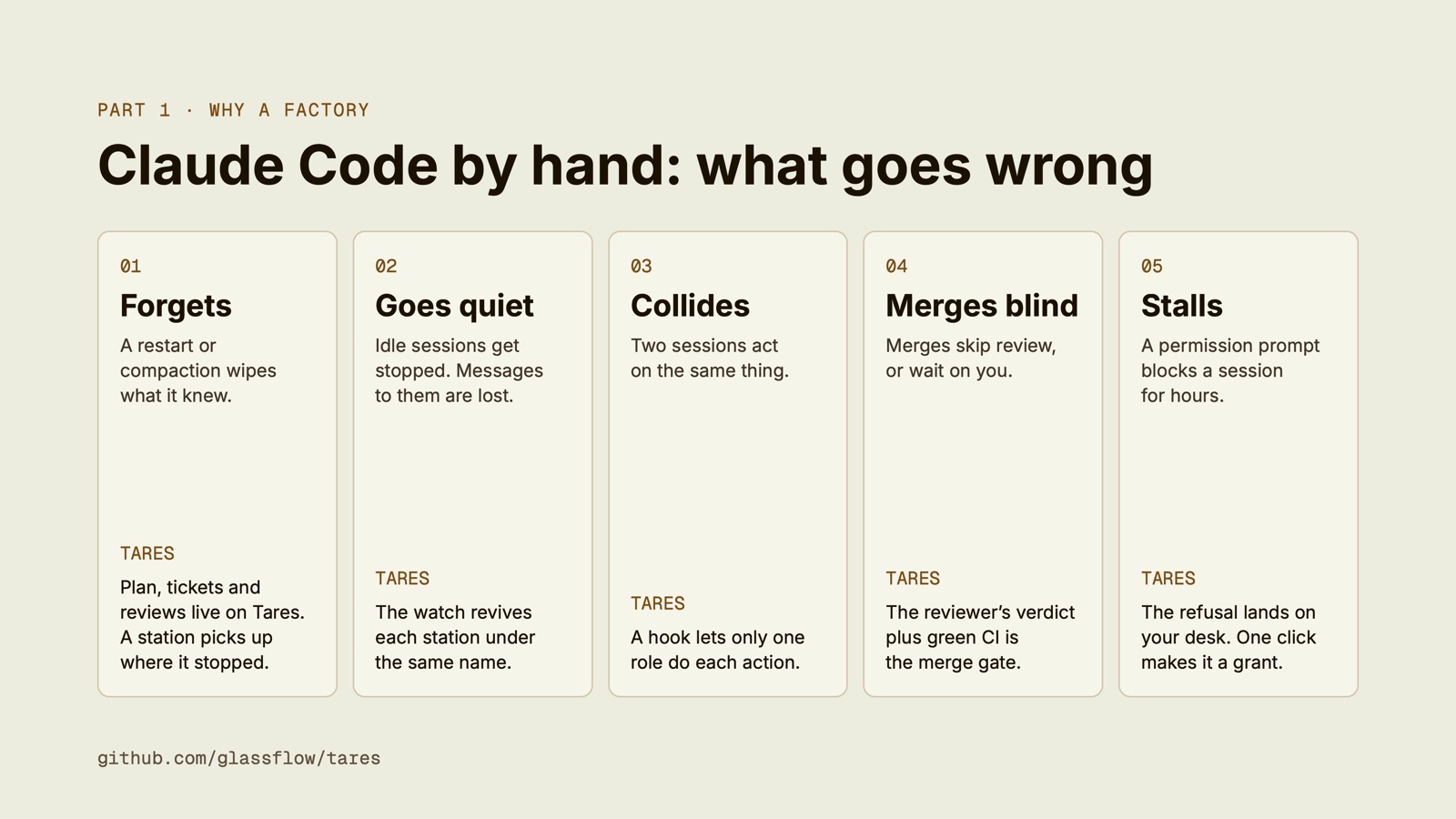
By September I had a habit. A dozen Claude Code sessions open, sometimes close to thirty in a day, one per repo or per idea. Each one was fast. I was the slow part.
I carried context from one session to the next. I checked whether the tests really ran. I typed “yes, merge it” twenty times a day. The model was not the bottleneck. I was.
So I tried to take myself out of the middle.
What a software factory is
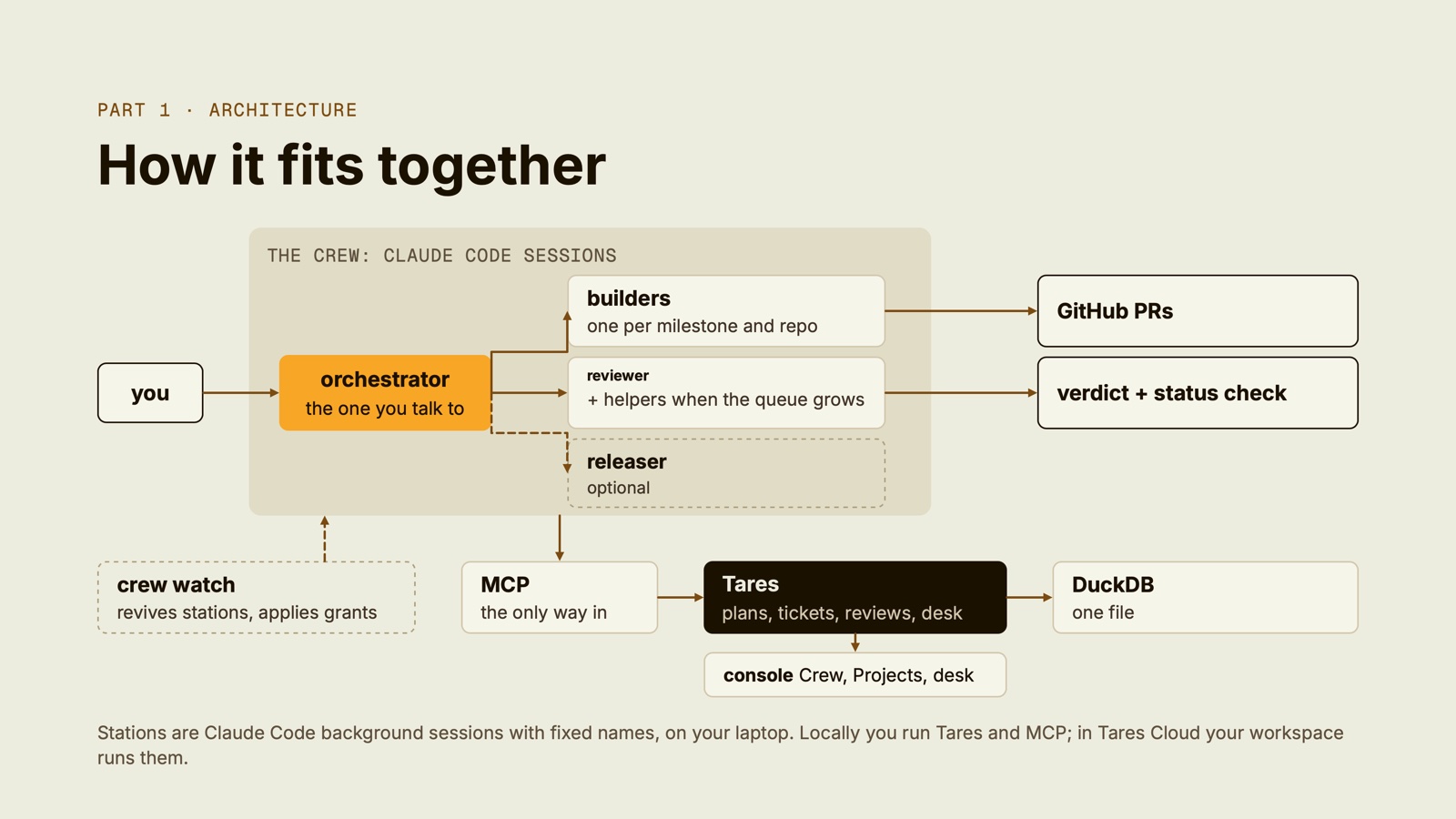
A software factory is a crew of Claude Code sessions that takes a plan and turns it into merged pull requests. Each session has one job and a stable name. They run on your own machine, on your own Claude plan. No API keys.
Ours is built into Tares, the open-source tool we build at GlassFlow. I started the factory part as a side repo in early October for a workshop demo, and a week later it became part of Tares.
The crew:
- Orchestrator. The only session you talk to. It hands out work, answers the others and brings you what needs you.
- Builders. One per repo for the current milestone. They write the code, the tests and the PR.
- Reviewer. Checks every PR before it can merge.
- Releaser (optional). Cuts a release when a milestone lands.
Everything the crew decides and everything you answer is written to Tares. If a session fills its context or stops, a fresh one picks up the same role with the same record. My favourite line from the slides: sessions come and go; the record stays.
How one piece of work flows
Say you want a click counter on a link shortener. That was our workshop demo.
- Plan together.
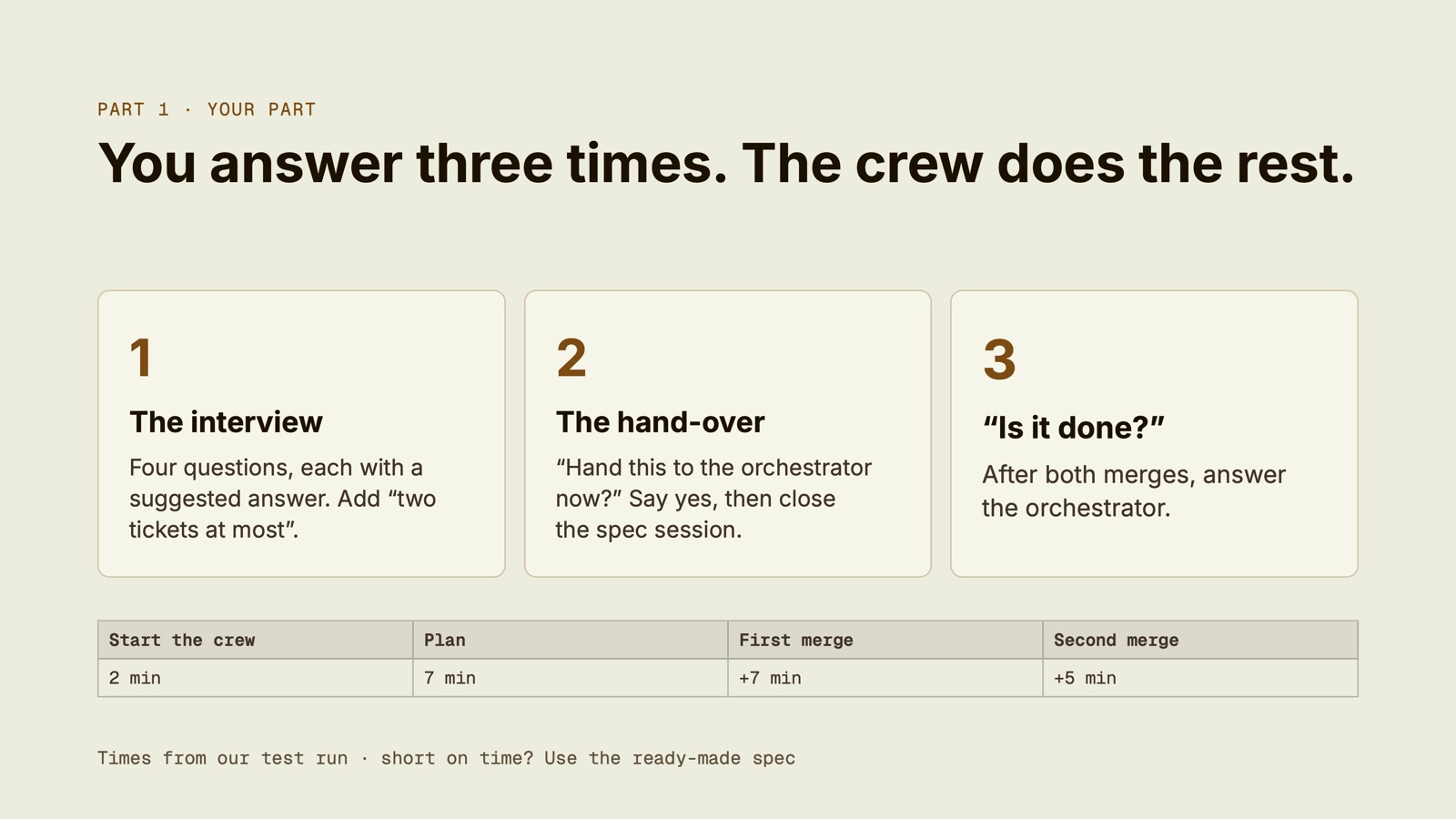
tares factory spec "add a click counter"reads the repo and interviews you, one question at a time, each with a recommended answer. A second model then pokes holes in the plan. You end up with a spec, milestones with acceptance checks, and tickets. - Build. The orchestrator starts a builder. The builder works in its own git worktree, writes the code and the tests, and proves each new test fails on broken code. Then it opens a PR.
- Review. The reviewer runs the tests itself instead of trusting the PR text, looks past the diff for anything else the change might break, and posts a verdict.
- Merge. Reviewer pass plus green CI is the gate. You choose how far the crew may go: every merge waits for your yes, or the crew merges on its own once the gate is green.
- Unknowns don’t block. When the crew hits something it doesn’t know, it writes down an assumption and keeps going. You confirm those once per milestone, not once per ticket.
- “Is it done?” At the end it asks you. You say yes.
From starting the crew to the last merge, the demo took about 30 minutes, 7 of them planning. It used about 5% of a 5-hour window on a Max plan.
What changed for me
The biggest change: I stopped juggling sessions. I type into one to three sessions a day now. Every question lands in the orchestrator, one at a time, with a recommendation attached, so most of my answers are “yes”.
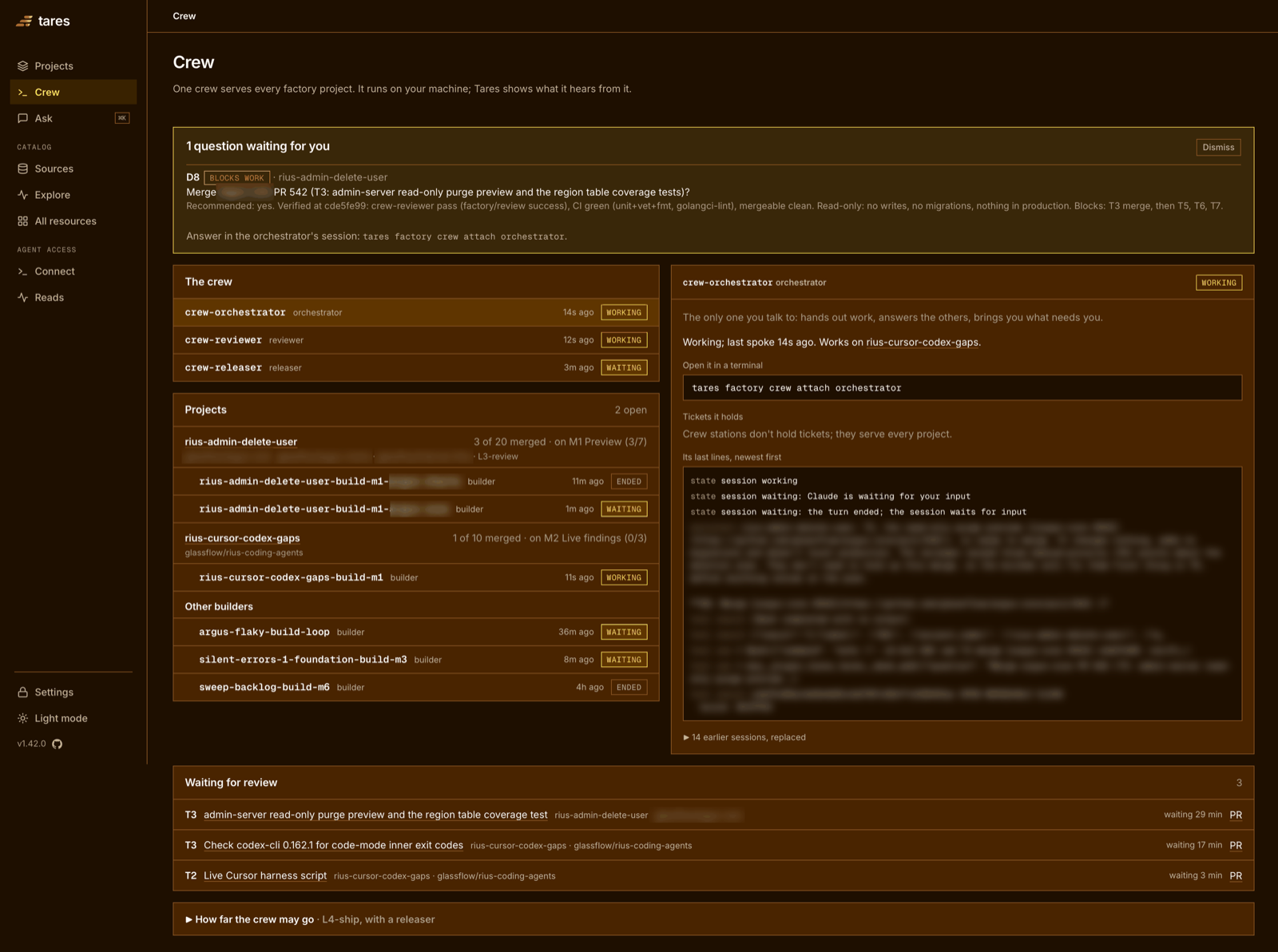
The second change: many projects at once. In October I had 12 projects running through the factory, with up to 7 of them merging on the same day. About a third of all merges landed between midnight and 8 in the morning, while I was asleep.
Some runs I’m happy about:
- A side project went through 202 PRs in four and a half days.
- lore, a public repo of mine, got 20 PRs in under a day.
- A docs project: 8 merged PRs in about 3 hours, and the crew needed only 5 answers from me.
- A refactor across repos: 17 PRs in half a day.
Compared with driving sessions by hand in September, I now merge about five times more PRs a day, and less than half as many need a follow-up fix within a week. A PR costs about 0.4% of a weekly Max 20x plan, roughly 20 cents of the $200.
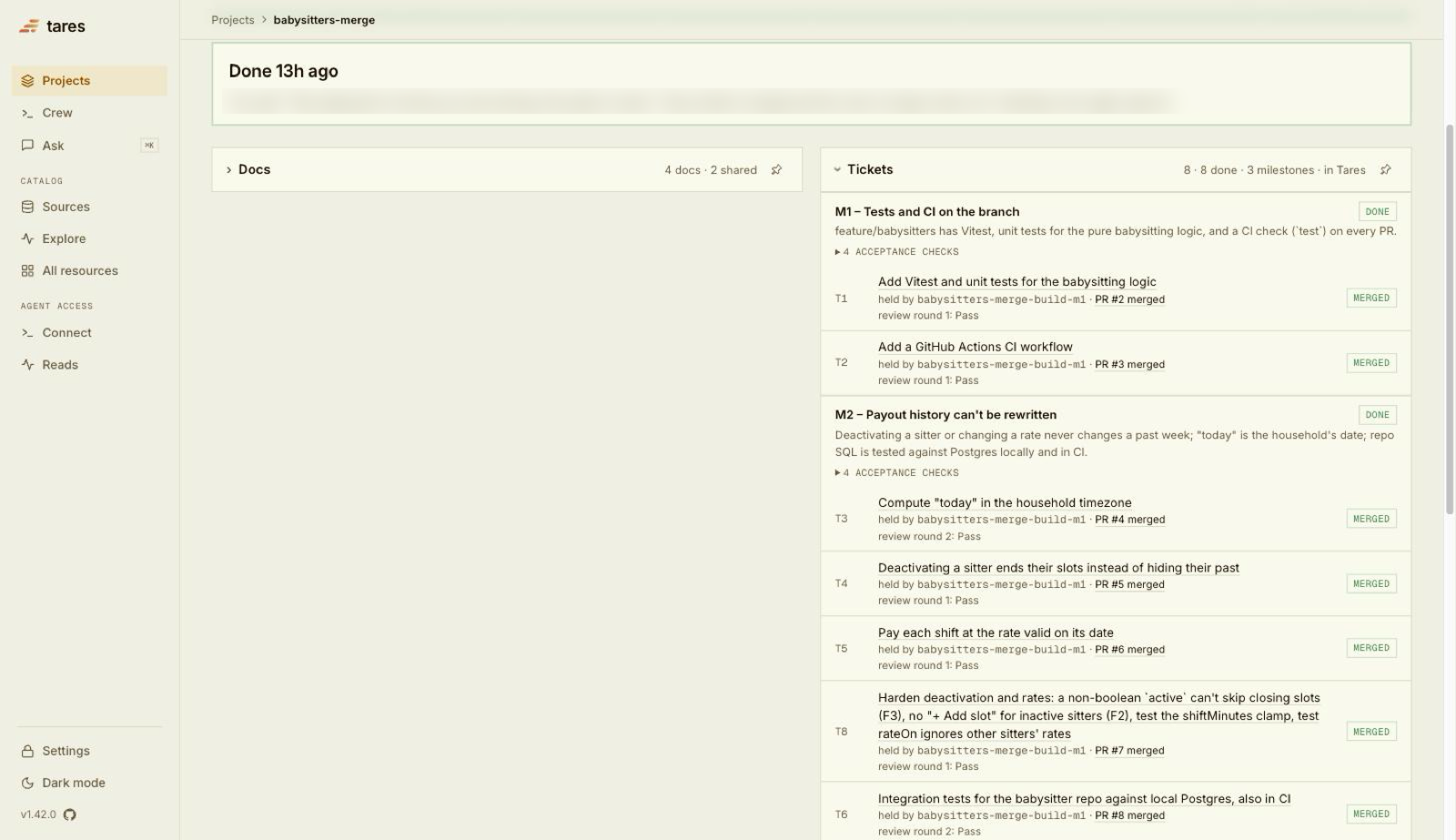
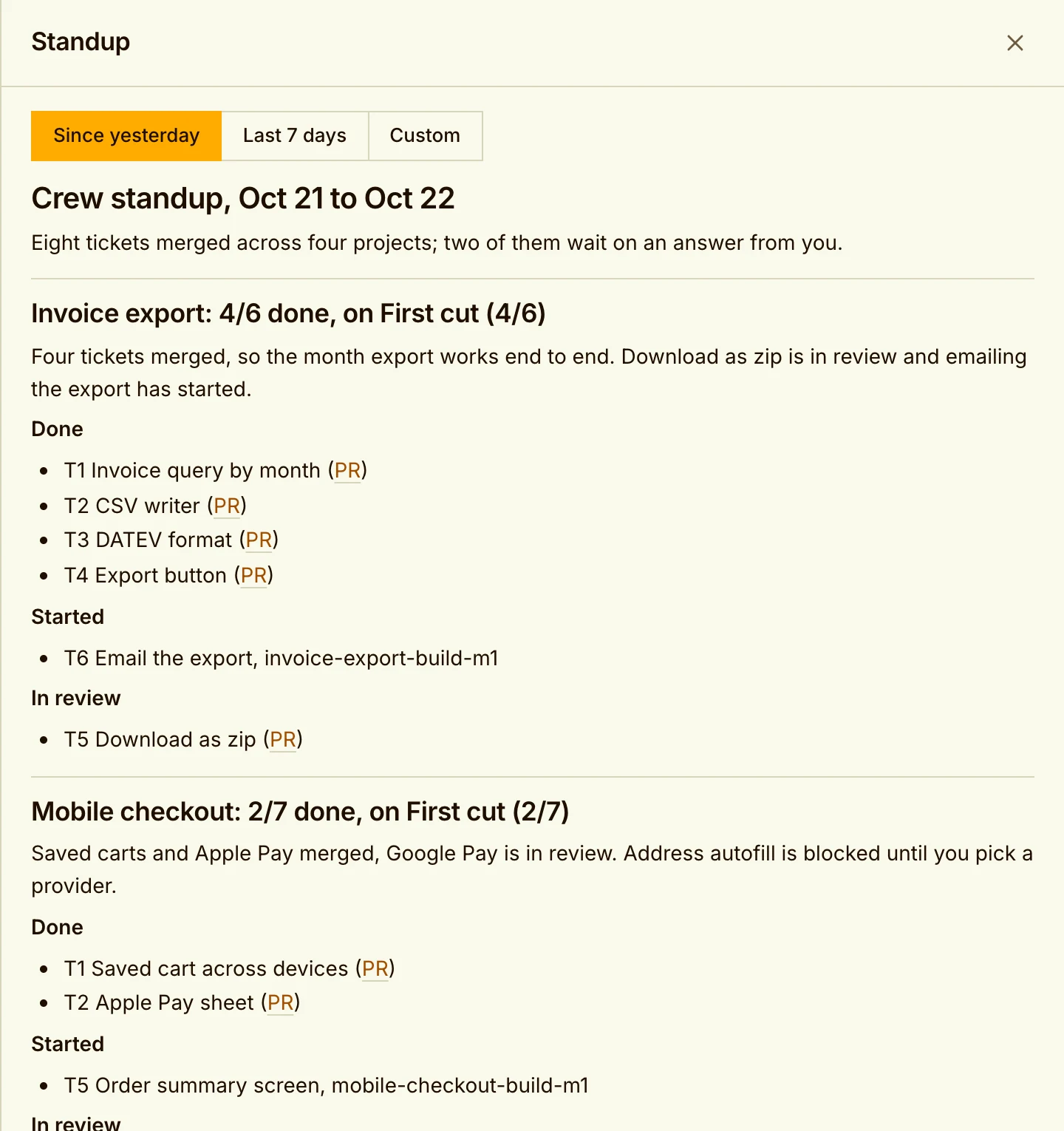
And every morning a standup is waiting for me:
What I hand it
- Planned feature work. Anything you can describe with acceptance checks. The spec interview does most of the thinking with you.
- Many small and medium projects in parallel. This is where it shines. One person, several projects moving at once.
- Changes across repos. One feature I shipped touched seven repos. Each repo gets its own builder and the orchestrator keeps them in step.
- The steady stream. Bugs coming in from Linear, flaky tests from CI, backlog sweeps. These run on a loop and turn into PRs.
- Tests, docs and refactors. The important work that never quite gets prioritised.
- Overnight work. Plan before dinner, read the standup at breakfast.
What I keep
The factory is great at work. People are great at decisions. So the human part is small, but it’s the part that matters:
- The plan and the product calls.
- Confirming assumptions.
- Choosing how far the crew may go.
- Saying “done”.
- Anything with real-world reach: production deploys, secrets, billing, talking to people.
The crew never messages people for you. When a permission gets refused, it lands on your desk, and one click turns it into a standing grant.
Rules that came from real runs
What I like most is how it keeps getting better. Every time something went sideways in a real run, it became a rule. Incidents become rules. A few favourites:
- Tests must fail on broken code. A test that passes either way proves nothing.
- Verify, don’t read. The reviewer runs things. It doesn’t trust what the PR description says.
- One owner per action. Only one station does a given thing, so nobody steps on anybody.
- Unknowns don’t block. Write the assumption down, keep moving, confirm later.
Claude Code changes its mechanics often. The method keeps working on top of them.
Try it
- Get started: docs.glassflow.ai/tares/software-factory
- Code: glassflow/tares (MIT)
- Run the workshop demo yourself: glassflow/factory-workshop-starter
- The slides: sudopower.com/tares-factory
- A short video from GlassFlow: What Is a Software Factory?
- How we run it as a team at GlassFlow, by Ashish: What is a software factory
I showed all of this at the Claude Community workshops in Berlin and Munich. Those posts are about the evenings themselves.
Agents do the work. People make the decisions. 🏭