Tares
software factory
A crew of Claude Code sessions that ships your projects.
It plans with you, builds, reviews and merges. Tares keeps the plan and your answers.
What
Tares is
Open source, MIT. One DuckDB file.
- 01
A lasting, shared record for AI agents
An open-source daemon that keeps it.
- 02
A software factory runs on it
A fixed crew of Claude Code sessions takes a planned project to merged pull requests.
- 03
You talk to one session
The orchestrator. You watch the rest in the console.
Claude Code by hand
What goes wrong, and what Tares does instead.
Forgets
A restart or compaction wipes what it knew.
Plan, tickets and reviews live on Tares. A station picks up where it stopped.
Goes quiet
Idle sessions get stopped. Messages to them are lost.
The watch revives each station under the same name.
Collides
Two sessions act on the same thing.
A hook lets only one role do each action.
Merges blind
Merges skip review, or wait on you.
The reviewer's verdict plus green CI is the merge gate.
Stalls
A permission prompt blocks a session for hours.
The refusal lands on your desk. One click makes it a grant.
Gaps Tares closes
| Gap | By hand | With Tares |
|---|---|---|
| Memory | Lost on restart | On Tares for the next session |
| Liveness | Dead for hours, unnoticed | The watch revives it |
| Ownership | Any session can merge | One owner per action |
| Review | Whatever the session decides | A fixed bar: tests proven to fail on broken code |
| Permissions | Prompts in every session | Grants for every station |
| Decisions | Scattered in chat | Desk and decision log |
| Overview | Many terminals | One console |
How it fits together
Stations are Claude Code background sessions with fixed names. Tares Cloud can run the daemon and MCP for you. Soon, the builders too.
One real run
A click counter, from the GlassFlow workshop guide.
$ tares factory crew up$ tares factory spec "add a click counter ...""Is it done?"in the orchestrator
About 30 minutes, end to end
PlanAbout 5% of the 5-hour limit, on a Max plan.
KeyNo Anthropic API key. The crew runs on Claude Code.
Crew
standup
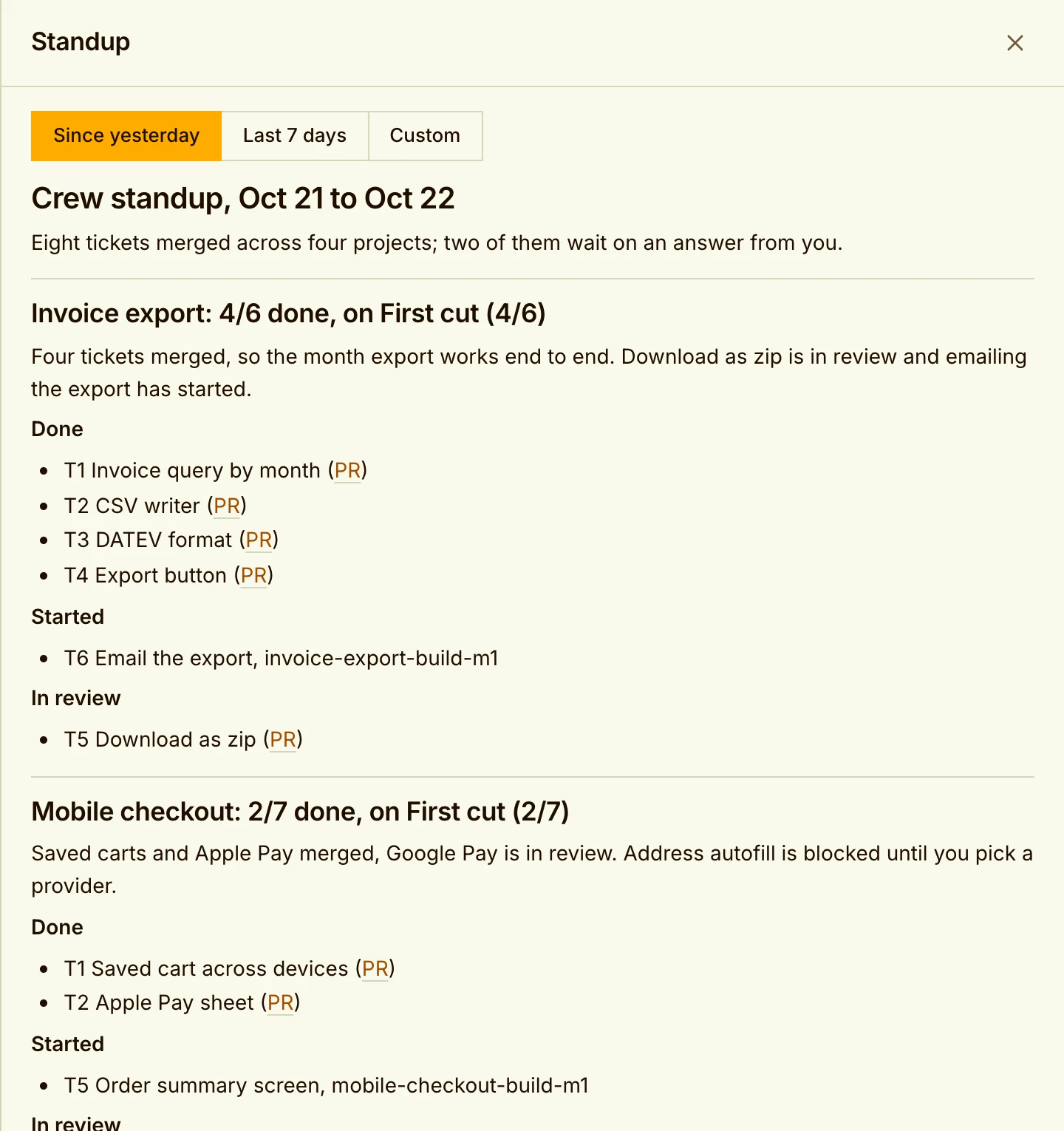
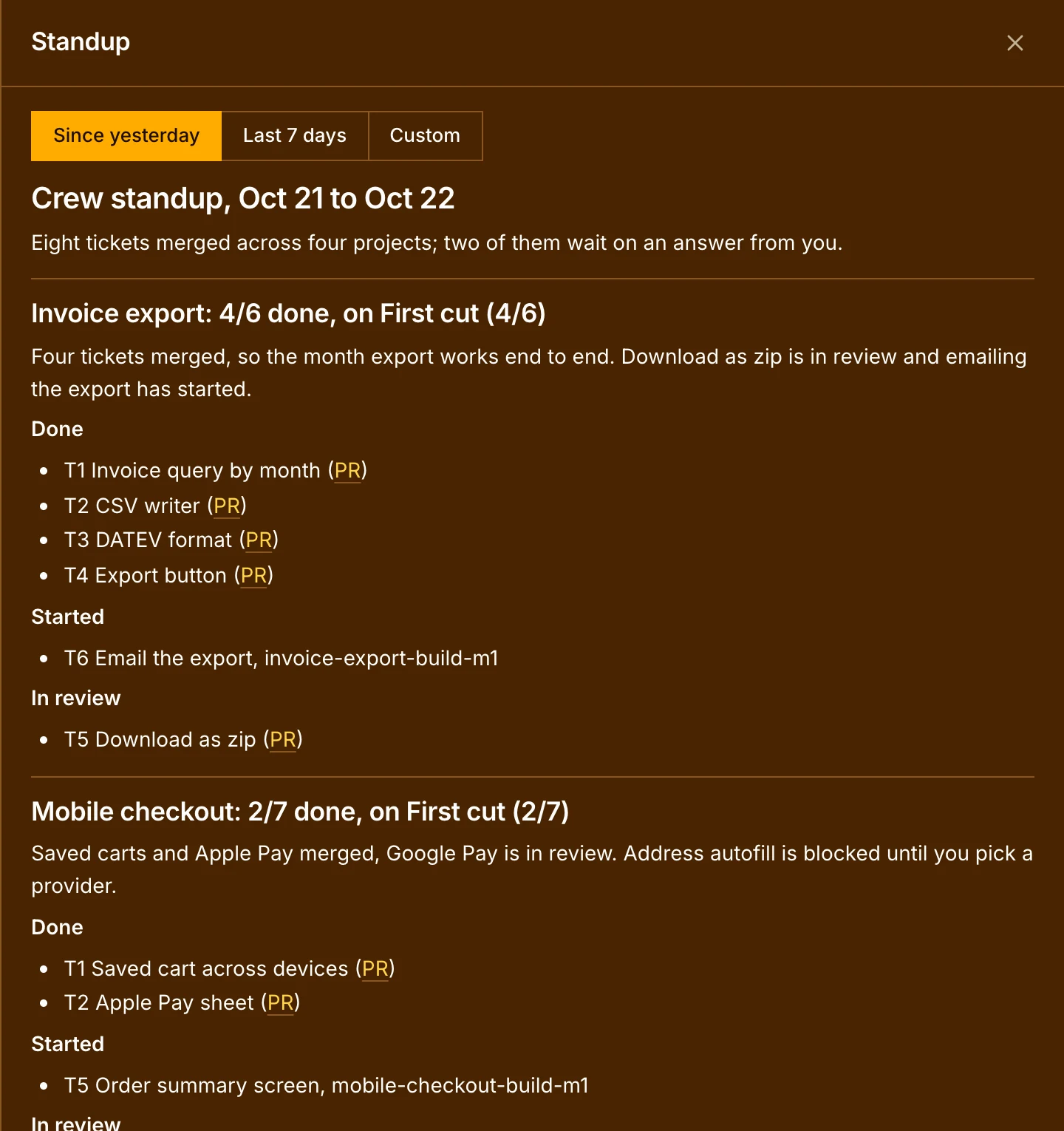
What moved in every project since yesterday, or over any dates. One button on the Crew page.
- Facts
- Done, started, in review, blocked and waiting on you, with PR links. Read from Tares, never made up.
- Summary
- The cell's model adds one line overall and one per project.
- Share
- Copy the markdown, or send it to a Slack channel.
Context rot
Long sessions fill their context window. Compaction then drops what matters.
What Tares does about it
- 01
Re-briefed after compaction
After any compaction or resume, a SessionStart hook tells the station who it is. It reloads its skills, re-reads its report and its work on Tares, and re-arms its schedule.
- 02
State outside the context
A report file and Tares hold the state. Compaction loses nothing that matters.
- 03
Room to work
200k tokens by default, at least 150k. At 100k a station refilled right after every compaction.
- 04
Thrash guard
The watch spots Claude Code's “autocompact is thrashing” stop and starts the station fresh under the same name.
- 05
In plain sight
The Crew page shows how near each station is to compacting, and its context by category on request.
No early warning at 50% or 70% yet. Nothing hands work over before compaction happens.
Incidents become rules
What we learned running it.
Two sessions approved the same three PRs in the person's name.
One owner per actionFour PRs merged in 23 minutes with no review.
The reviewer's verdict is the gateThe reviewer was dead for two days. A review request sat 3 hours.
The watch24 parallel scans froze the Mac for 1h45m and lost every session.
Heavy commands one at a time, about 6 stations max161 auto-mode denials. The person ran git push by hand.
What's
unique
Compared with Claude Code and coding agents in general.
- 01
One owner per action
A guard hook enforces it, and runs heavy commands one at a time.
- 02
A second model reviews
Optional: Codex reviews every commit and blocks on serious findings until fixed.
- 03
Tests must fail on broken code
The reviewer proves each new test fails against broken code.
- 04
Not only for code
The same store serves timelines and triggers for other agents, such as an AI SRE.
- 05
Any MCP agent WIP
Works with any MCP agent, not only Claude Code.
Factory
for teams
Building now: one cell for the whole team, with a crew for each person.
- 01
A crew for each person
Many people on one cell, each with their own crew.
- 02
Projects with a lead
Shared with the team, or private to its members.
- 03
Questions reach the right person
The ticket's assignee, or whoever owns that repo.
- 04
Sign-off before the build
Each repo's owner signs off on the plan first.
- 05
Every change says who
Tickets, reviews, grants and memory record the person.
In progress
Runs today on your Claude Code plan and gh. What comes next:
- Testing
Crews across machines: a homelab of spare Mac minis and an M1, lids closed, building on their own.
- Soon
Linux and Windows support, after macOS.
- Next
The crew acts through the Tares GitHub App, so reviews become real approvals.
- By design
Claude Code changes its mechanics often. The method keeps working on top of them.
Roadmap
Now
Shipped- A daily standup, sent to SlackCloses"what did the crew do overnight?"
- One-click grants for refusalsClosesstalled stations
- Usage, context and progress ringsClosescost blindness
- Tickets from GitHub Issues tooClosesneeding Linear
Next
Planned- Software factory for teamsClosesone person, one crew
- Reviews in parallel, sized by PRClosesa review queue that waits
- Bring your CLAUDE.md and memoryClosesrules the crew never sees
- A cap on your plan's usageClosesa crew that eats your week
Later
Proposals- Builders and workers in the cloudClosesthe crew sleeping when your laptop does
- Remote Control from the Claude appClosessteering only from the terminal
- Monitor, security and comms stationsClosesalerts, scans and Slack outside the crew
- One command back after a rebootClosesrestarting the crew by hand
Run your
own crew
Open source, MIT. Runs on Claude Code.
